We Are All Trying Here Kdrama: Complete Review, Cast, Story & Ending Guide (2026)
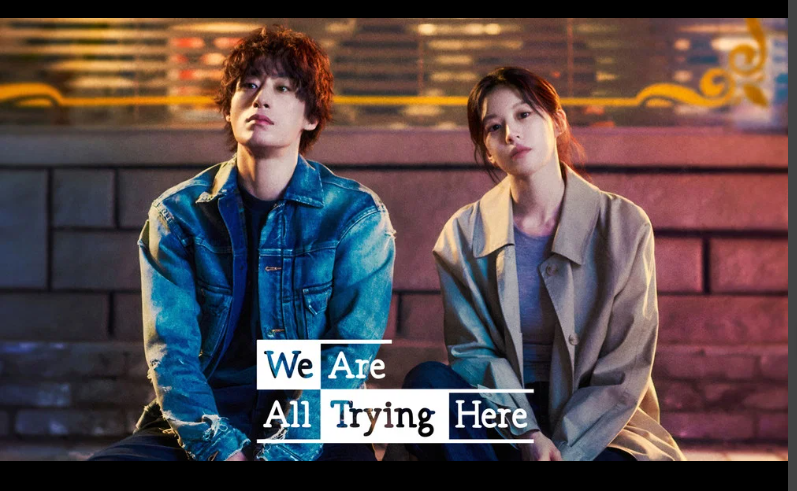
Featured Image Alt Text: We Are All Trying Here 2026 Kdrama official poster — Koo Kyo-hwan and Go Youn-jung Cast Image Alt Text: We Are All Trying Here main cast Koo Kyo-hwan, Go Youn-jung, Oh Jung-se, Kang Mal-geum Drama Poster Alt Text: JTBC Netflix drama We Are All Trying Here 2026 Korean title 모두가 자신의 무가치함과 싸우고 있다 Screenshot Alt Text: Hwang Dong-man and Byeon Eun-a scene from We Are All Trying Here Episode 1 JTBC
Introduction: The Drama That Speaks the Quiet Part Aloud
There’s a particular kind of loneliness that comes not from being alone, but from watching everyone around you seem to succeed while you’re still standing at the starting line. That feeling — the one most people admit only at 2 a.m. — is exactly where We Are All Trying Here begins.
Released on JTBC and Netflix in April 2026, this twelve-episode Korean drama arrived quietly and then hit the internet like a slow tide that doesn’t stop rising. It isn’t a show about explosions, love triangles, or corporate conspiracies. It’s about a man who has written fourteen screenplays and directed none of them. It’s about a woman who can dissect everyone else’s emotional wounds but refuses to look at her own. It’s about a group of friends who once shared a dream, and what happens to the friendships when the dream treats them unequally.
From the pen of Park Hae-young — the writer behind the revered My Mister (2018) and My Liberation Notes (2022) — and directed by Cha Young-hoon of When the Camellia Blooms fame, the drama carries unmistakable creative DNA. Viewers who thought they knew what they were getting into with another slice-of-life Kdrama quickly discovered something far more layered and uncomfortable: a show brave enough to look at envy, inadequacy, and the fear of worthlessness without blinking first.
Quick Drama Facts
| Detail | Information |
|---|---|
| Korean Title | 모두가 자신의 무가치함과 싸우고 있다 |
| Literal Translation | Everyone Is Fighting Their Own Worthlessness |
| Genre | Black Comedy, Slice of Life, Melodrama, Psychological Drama |
| Episodes | 12 |
| Release Date | April 18 – May 24, 2026 |
| Broadcast Schedule | Saturday & Sunday nights (JTBC) |
| Runtime | Approx. 70 minutes per episode |
| Director | Cha Young-hoon |
| Writer | Park Hae-young |
| Network | JTBC (South Korea) |
| Streaming Platform | Netflix (selected regions) |
| Production Companies | Studio Phoenix, SLL, Studio Flow |
| Music | Gaemi |
| Country | South Korea |
| Content Rating | 15+ / TV-MA |
| MyDramaList Score | 8.5 / 10 |
What Is We Are All Trying Here About?
At its simplest, We Are All Trying Here is a character study about people trapped between who they wanted to become and who they actually are. The drama is set within the Korean film industry and centres on “The Eight” — a group of filmmakers who bonded during their university film club days and have since gone on to build impressive careers. All of them, except one.
That one is Hwang Dong-man. He’s written fourteen screenplays over twenty years. Not a single frame has been shot under his direction.
Rather than collapsing inward under this weight, Dong-man has constructed an elaborate defence system: loud opinions, relentless critiques of everyone else’s work, performative mentorship, and an almost aggressive refusal to acknowledge his own stagnation. He’s exhausting to be around — deliberately, intentionally so. The drama wants you to feel the friction before it earns your sympathy.
His path intersects with Byeon Eun-a, a sharp film producer known professionally as “The Axe” for her brutally honest script assessments. Behind the professional armour, she’s running from childhood trauma rooted in maternal neglect — emotions she has buried so deep they’ve started reshaping how she moves through the world.
This is a spoiler-light drama in the best sense: knowing the premise barely scratches the surface of what the show actually delivers.
Plot Summary: A Story Worth Sitting With
The narrative engine of We Are All Trying Here is deceptively simple: what does it feel like to be left behind by your own ambition?
Hwang Dong-man occupies a strange social position within “The Eight.” He is both insider and outsider — beloved enough to be included in every dinner, gathering, and group chat, yet marked by the silent awareness that he is the only one who hasn’t made it. His response to this has calcified over two decades into something almost theatrical: he dominates conversations with harsh criticism dressed up as wisdom, positions himself as a mentor to people who are objectively more successful than him, and deflects any genuine vulnerability with noise.
Into this dynamic steps Byeon Eun-a, who works at Choi Film as a producer. Her professional reputation is sterling; her emotional interior is another matter entirely. A childhood defined by a mother who was physically present but emotionally absent has left Eun-a with a deep-seated terror of dependency. She’s learned to assess everyone else’s feelings with clinical precision while keeping her own locked behind a professional façade. The Axe cuts scripts; it turns out she’s equally good at cutting off her own emotional access.
The drama’s most sophisticated layer is the constellation of secondary characters who surround them — each carrying their own version of the central theme. Park Gyeong-se is a film director whose recent commercial failure has cracked open his carefully maintained image. His wife, Ko Hye-jin, CEO of Gobak Film, is one of the drama’s most surprising emotional centres — a woman whose patience, groundedness, and sheer capacity for compassion slowly becomes the moral backbone of the entire ensemble.
Hwang Jin-man — Dong-man’s older brother and a former poet of some renown — moves through the story like a figure from a different, darker genre. His relationship with art, failure, and self-destruction illuminates the path Dong-man is trying desperately not to take.
What binds all of these threads is the drama’s refusal to simplify any of its characters into villains or saints. Every person in “The Eight” is carrying something. Every moment of cruelty has a traceable wound behind it. And every small act of grace between characters lands with genuine weight.
Main Cast and Characters
Lead Cast
Koo Kyo-hwan as Hwang Dong-man Known internationally for his magnetic, unpredictable work in D.P. (2021) and Decision to Leave (2022), Koo Kyo-hwan delivers what many viewers are already calling a career-defining performance. Dong-man is a role that could easily tip into caricature — an irritating, self-deluded man who makes every conversation about himself. Instead, Koo layers the character with extraordinary specificity: the way Dong-man’s eyes shift when he’s been genuinely heard, the particular timing of his deflections, the physical vocabulary of a man who has learned to take up space because he fears the alternative. Viewers who start the drama wanting to shake him often end it wanting to hug him.
Go Youn-jung as Byeon Eun-a Following her breakout international visibility in Sweet Home and A Shop for Killers, Go Youn-jung makes a definitive creative statement here. Eun-a demands a different register entirely from those projects — less visceral intensity, more interior excavation. Go navigates her character’s emotional architecture with precision, making Eun-a’s defences feel completely earned rather than arbitrary. Her scenes with Koo Kyo-hwan generate a specific chemistry: two people who understand each other’s broken parts without fully understanding their own.
Oh Jung-se as Park Gyeong-se Few actors in Korean drama are as consistently excellent at portraying masculine fragility without condescension as Oh Jung-se, and Park Gyeong-se is a showcase for exactly that skill. A director whose recent film bombed at the box office, Gyeong-se is consumed by the particular agony of public failure — and his response to that agony is both recognisable and deeply uncomfortable. Oh Jung-se finds the pathetic and the pitiable simultaneously present in every scene, making Gyeong-se one of the drama’s most rewarding emotional journeys.
Kang Mal-geum as Ko Hye-jin Perhaps the drama’s most quietly radical character. Ko Hye-jin — CEO of Gobak Film and Gyeong-se’s wife — could have been written as the long-suffering spouse. Instead, Park Hae-young has created a woman of enormous emotional intelligence and strategic patience whose perspective on every other character is essentially the most accurate in the room. Kang Mal-geum, remarkable in Juvenile Justice and The Midnight Studio, brings a warmth and specificity to Hye-jin that makes her feel genuinely irreplaceable to the drama’s moral fabric.
Park Hae-joon as Hwang Jin-man Hwang Dong-man’s older brother is the ghost haunting the edges of the story — a former poet whose relationship with failure, creativity, and self-destruction holds up a dark mirror to Dong-man’s predicament. Park Hae-joon, reliably excellent in supporting and antagonist roles (The World of the Married, Crash Course in Romance), brings a layered menace and unexpected tenderness to Jin-man that makes him one of the most talked-about characters in the ensemble.
Bae Jong-ok as O Jeong-hui Veteran actress Bae Jong-ok brings enormous authority to O Jeong-hui, a character whose relationship with the group adds generational texture to the drama’s themes about career, ambition, and the slow erosion of early dreams.
Supporting Cast
Han Sun-hwa as Jang Mi-ran and Choi Won-young as Choi Dong-hyeon round out the primary ensemble alongside additional cast members who flesh out “The Eight” and the broader film industry world the drama inhabits. The sheer volume of strong performances across the supporting tier is one of the production’s most consistent achievements.
Cast image alt text: We Are All Trying Here 2026 full ensemble cast including Koo Kyo-hwan, Go Youn-jung, Oh Jung-se, Kang Mal-geum, Park Hae-joon, Bae Jong-ok, Han Sun-hwa, Choi Won-young
Character Relationships Explained
The relationship architecture in We Are All Trying Here is one of its most sophisticated elements. At its centre sits the tentative, hard-won friendship between Dong-man and Eun-a — not a romance built on meet-cute moments, but one assembled from shared discomfort and mutual recognition. They understand each other not despite their damage but through it.
Around this axis, the drama arranges its other relationships with care. Park Gyeong-se and Ko Hye-jin’s marriage is presented not as a simple success-or-failure binary but as a living document of two people trying to remain in each other’s orbit as they individually change. The separation that emerges in the story’s later chapters is handled with a complexity that refuses to assign blame cleanly.
The brotherhood between Hwang Dong-man and Hwang Jin-man functions as the drama’s emotional dark matter — its gravitational pull is felt even when the siblings aren’t on screen together. Jin-man is what Dong-man fears becoming; Dong-man is what Jin-man has given up trying to be.
“The Eight” as a collective represents something the drama takes seriously: the way long friendships between ambitious people can become simultaneously a source of profound comfort and unbearable pressure.
Themes and Meaning Behind the Story
The Architecture of Envy
Unlike dramas that treat envy as a moral failing, We Are All Trying Here approaches it as a structural condition. Envy, in Park Hae-young’s hands, is what happens when talent meets unequal outcomes — when people who started in the same place end up in radically different ones. The drama asks: is envy really about wanting what others have, or is it about the fear that you deserved the same and didn’t receive it?
Worthlessness as a Shared Human Experience
The literal Korean title — Everyone Is Fighting Their Own Worthlessness — is perhaps the most honest drama title in recent Kdrama history. The show argues, carefully and with great specificity, that the sense of being not enough is not exceptional. It is ambient. It affects the successful and the struggling alike; it just looks different depending on how much external validation a person has managed to accumulate.
The Performance of Competence
Both lead characters — Dong-man and Eun-a — have constructed elaborate professional identities that keep their actual fears at arm’s length. Dong-man performs authority. Eun-a performs invulnerability. The drama’s emotional progress is measured by the gradual, costly collapse of these performances.
Friendship Under Pressure
The drama treats adult friendship with the seriousness it rarely receives in popular culture. The relationships within “The Eight” have survived two decades of diverging fortunes, and the show is honest about the cost: some bonds are stretched to breaking, some moments of cruelty within friendships are never fully repaired, and some of the most meaningful connections exist in the space of unspoken mutual acknowledgment.
The Relationship Between Art and Self-Worth
Set within the Korean film industry, the drama has something specific and pointed to say about creative labour and identity. When your art is also your career is also your sense of self-worth, failure at one cascades through the others in ways that can be genuinely destabilising.
What Makes We Are All Trying Here Different From Other Kdramas?
The most honest answer is also the simplest: this drama trusts its audience.
Most slice-of-life Korean dramas about adult life and loneliness — even excellent ones — deploy moments of warmth and humour as palate cleansers to prevent the heaviness from becoming too much. We Are All Trying Here does something bolder: it lets you sit in the discomfort. Dong-man is written to be genuinely irritating in early episodes, not as a trick but as an act of dramatic honesty. The payoff of understanding him requires the investment of finding him difficult first.
Compared to My Liberation Notes (2022), the tonal relative viewers most frequently cite, this drama is angrier — less meditative, more confrontational. Where My Liberation Notes moved at the pace of someone processing quietly, We Are All Trying Here moves at the pace of someone trying not to fall apart in a room full of people who don’t know that’s happening.
The production quality reinforces this distinction. Director Cha Young-hoon, who demonstrated exceptional ability to balance emotional depth with visual warmth in When the Camellia Blooms and Welcome to Samdal-ri, deploys a visual language here that is noticeably more controlled and interior. The cinematography leans toward tighter frames in emotionally loaded scenes — faces filmed with enough proximity that micro-expressions become plot points.
The ensemble nature of the storytelling also sets it apart. While the drama has clear protagonists, it genuinely invests in all of its characters in a way that makes the world feel populated rather than decorative.
Cinematography, Visual Style and Direction
Director Cha Young-hoon approaches We Are All Trying Here with a restrained formalism that suits the material precisely. His previous work demonstrated a fluency with warm, community-rooted visual storytelling; here he pivots toward something more controlled and inward. The colour palette favours muted earth tones and cool urban greys, interrupted by the occasional warm pool of light that tends to appear in scenes of genuine human connection — a visual shorthand for emotional temperature that never feels heavy-handed.
The drama’s treatment of space is worth noting. Interior scenes — particularly those in the intimate settings where characters reveal themselves to each other — are composed with notable deliberateness. Depth of field is used strategically, frequently keeping background characters softly out of focus in ways that mirror the subjective experience of emotional preoccupation. Outdoor scenes tend to breathe more openly, with a few memorable sequences that contrast the smallness of the characters against the scale of the city they’re navigating.
The filming in Canada (referenced during Go Youn-jung’s preparation period) contributes to specific sequences that carry a visual quality distinct from the drama’s Korean-set scenes — a geographic shift that mirrors a corresponding emotional one for the characters involved.
The OST, composed by Gaemi, complements the visual approach with restraint. The music serves the scenes rather than directing emotional responses, a choice consistent with Park Hae-young’s writing philosophy.
Audience Reactions and Reviews
We Are All Trying Here has generated the kind of response that drama fans tend to describe in terms of personal testimony rather than conventional review language. The Korea Times described it as “creating a quiet sensation,” with fans claiming that “not a single line of dialogue is wasted” and that they “savor each episode carefully.”
On MyDramaList, where it holds a score of 8.5 from nearly 8,000 users, the most upvoted reviews converge on a few consistent points: the ensemble is exceptional without exception, the writing achieves a balance of comedy and devastation that few dramas manage, and the character of Hwang Dong-man in particular is cited as one of the most memorable Kdrama leads in recent memory.
Viewer discussions have been particularly animated around the question of whether Dong-man is sympathetic in early episodes — with many noting that they initially found him “frustrating” or “irritating” before the drama revealed the emotional architecture beneath the bluster. This appears to be the intended experience rather than a miscalculation.
Dramabeans, one of the most respected English-language Kdrama commentary communities, has covered the series week by week, with recaps generating significant comment engagement — a reliable indicator of a drama that generates genuine discussion rather than passive consumption.
Asian Wii and Reddit communities have produced threads explicitly identifying the drama as speaking to “people who know what it’s like to keep trying and still come up short” — a description that has resonated enough to be widely shared and quoted.
Strengths and Weaknesses
Strengths
Extraordinary ensemble acting. Every principal cast member is performing at a demonstrably high level, and the chemistry between them — particularly Koo Kyo-hwan and Oh Jung-se, who share some of the drama’s most tense scenes — is exceptional.
Park Hae-young’s writing at full power. As with My Mister and My Liberation Notes, her dialogue operates on multiple levels simultaneously. A conversation that appears to be about a screenplay is actually about a marriage. A scene that looks like professional conflict is actually about inherited patterns of self-destruction.
Tonal intelligence. The drama’s classification as “black comedy” is earned. It finds genuine, specific humour in the situations its characters create without ever making those situations less serious.
Character specificity. No one in this drama feels like a type. Every character has habits, speech patterns, and blind spots that feel observed rather than constructed.
Weaknesses
The early-episode friction is a feature with costs. Dong-man’s intentional irritating quality in episodes one through three generates the emotional payoff that follows, but it does mean the drama has a higher attrition rate among casual viewers than its quality warrants.
The ensemble depth can scatter focus. With six fully developed primary characters, the drama occasionally moves between storylines in ways that interrupt emotional momentum — particularly in the middle episodes, where Gyeong-se and Hye-jin’s arc occasionally competes with the central relationship for attention.
Runtime. At approximately seventy minutes per episode, some viewers find the pacing demands more patience than contemporary streaming habits typically accommodate.
The Ending Explained (Spoiler Section)
Note: The following section contains major spoilers. Skip to “Similar Kdramas” below if you haven’t finished the series.
The finale of We Are All Trying Here makes a deliberate choice to end not on dramatic resolution but on earned emotional movement — consistent with Park Hae-young’s established approach to closure.
Hwang Dong-man’s arc concludes with him finally on the threshold of his first directorial debut. The drama is careful not to make this a triumphant moment of arrival — the ending makes clear this is a beginning, not a conclusion. The actual debut is framed as a starting point, with all the uncertainty that implies, rather than a vindication of twenty years of effort. What changes is not his external circumstances so much as his relationship to his own worth: Dong-man ends the series capable of asking for help, capable of being genuinely seen by another person, capable of beginning.
Byeon Eun-a’s trajectory involves confronting the maternal wound that has organised her emotional life for decades. Her path toward the relationship she and Dong-man have been building across the series is not straightforward; it involves several painful retreats before a more genuine advance. The drama doesn’t offer easy reconciliation with the past — it offers something more modest and more true: the possibility of moving toward people rather than away from them.
Park Gyeong-se and Ko Hye-jin’s marriage reaches a point of genuine uncertainty. The separation is honest rather than temporary-conflict neat. The ending suggests the possibility of reconnection without mandating it — a reflection of the drama’s wider resistance to tidy resolution.
Hwang Jin-man’s arc — the drama’s most painful — moves toward a tentative resumption of his relationship with writing. Whether that constitutes recovery in any meaningful sense is left deliberately open.
The Korea Times characterised the ending as answering “the fear of worthlessness” — not by removing that fear but by demonstrating, through all eight characters, that it is survivable.
Similar Kdramas To Watch Next
If We Are All Trying Here has found a place in your emotional vocabulary, these dramas share either its thematic concerns, visual sensibility, or emotional register:
My Mister (2018) — Written by the same author, Park Hae-young. Slower, quieter, and arguably even more devastating. Required viewing for anyone who responds to this drama’s wavelength. (Internal link: My Mister Kdrama full review)
My Liberation Notes (2022) — Park Hae-young again. Three siblings trying to outrun the boredom and smallness of their lives. The drama most frequently cited alongside We Are All Trying Here in viewer comparisons. (Internal link: My Liberation Notes complete guide)
When the Camellia Blooms (2019) — Director Cha Young-hoon’s earlier work. A warmer, more genre-conventional piece but with his characteristic attention to emotional specificity. (Internal link: When the Camellia Blooms review)
Reply 1988 (2015) — The gold standard of ensemble Korean drama about friendship and the passage of time. Different in tone but comparable in its investment in a community of characters. (Internal link: Reply 1988 streaming guide)
Thirty-Nine (2022) — Female-centred ensemble about friendship in middle age. Less interested in professional failure than We Are All Trying Here but equally serious about emotional honesty.
Misaeng: Incomplete Life (2014) — The definitive Korean workplace drama about not belonging. Shares the film’s interest in systems that create and exclude. (Internal link: Misaeng Kdrama review)
Another Miss Oh (2016) — Also written by Park Hae-young. Viewers who want to explore her body of work will find similar emotional precision in a more conventionally romantic framework.
Where To Watch We Are All Trying Here
Netflix streams We Are All Trying Here in selected regions internationally, making it accessible to the global Kdrama audience. It is the primary legal streaming option for viewers outside South Korea.
JTBC broadcast the drama in South Korea, with episodes airing Saturday nights at 22:40 KST and Sunday nights at 22:30 KST during its original run (April 18 – May 24, 2026). JTBC’s own digital platforms carry the series for South Korean viewers.
Regional availability on Netflix varies. Viewers in some markets may need to explore alternative legal regional streaming services. It is always worth checking current availability, as streaming rights for Korean dramas update regularly.
Is We Are All Trying Here Worth Watching?
Yes — but with a specific qualification: this drama rewards patience and investment in a way that passive viewing won’t unlock.
If you come to We Are All Trying Here expecting the comfort rhythms of a standard Korean romance or the clean emotional architecture of a more conventional melodrama, the early episodes may feel disorienting. Dong-man is not an easy entry point. The ensemble structure means the emotional focus distributes rather than concentrating in a way that delivers immediate gratification.
What it offers instead is something rarer: a drama that treats its audience as capable of holding complexity, discomfort, and ambiguity simultaneously. By the time the final episode concludes, the series has made a case — through character, dialogue, and accumulated emotional evidence — that trying, in the absence of guarantee, in the face of envy and inadequacy and the quiet horror of comparison, is itself a form of dignity.
For viewers who have felt stuck — professionally, creatively, emotionally — this drama doesn’t offer solutions. It offers company. And at its best, that is the highest thing a piece of storytelling can do.
Verdict: 9/10 — One of the finest Korean dramas of 2026, and an essential work in Park Hae-young’s remarkable body of writing.
Frequently Asked Questions
1. Who are the main cast members of We Are All Trying Here? The lead cast includes Koo Kyo-hwan as Hwang Dong-man, Go Youn-jung as Byeon Eun-a, Oh Jung-se as Park Gyeong-se, Kang Mal-geum as Ko Hye-jin, Park Hae-joon as Hwang Jin-man, Bae Jong-ok as O Jeong-hui, Han Sun-hwa as Jang Mi-ran, and Choi Won-young as Choi Dong-hyeon.
2. How many episodes does We Are All Trying Here have? The drama runs for 12 episodes, each approximately 70 minutes long.
3. When did We Are All Trying Here premiere and finish airing? The drama premiered on April 18, 2026 and concluded on May 24, 2026 on JTBC. It aired on Saturday and Sunday nights.
4. Where can I watch We Are All Trying Here outside South Korea? We Are All Trying Here is available on Netflix in selected regions internationally.
5. What genre is We Are All Trying Here? The drama is classified as a black comedy, slice-of-life drama, melodrama, and psychological drama. It blends dry humour with emotionally serious character study.
6. Who wrote and directed We Are All Trying Here? The screenplay was written by Park Hae-young, also known for My Mister (2018) and My Liberation Notes (2022). The series was directed by Cha Young-hoon, director of When the Camellia Blooms (2019) and Welcome to Samdal-ri (2023–2024).
7. Does We Are All Trying Here have a happy ending? The ending is hopeful rather than conventionally happy. Characters make meaningful emotional progress — Dong-man moves toward his directorial debut, Eun-a takes steps toward genuine connection — but the drama resists tidy resolution, consistent with Park Hae-young’s writing philosophy.
8. Is We Are All Trying Here similar to My Liberation Notes? Yes — both are written by Park Hae-young and share a similar emotional wavelength, with an interest in quiet desperation, ensemble character work, and the struggle for meaning in ordinary adult life. We Are All Trying Here is generally considered slightly more confrontational in tone.
9. Is We Are All Trying Here appropriate for teenagers? The drama carries a 15+ rating in South Korea and a TV-MA rating on some international platforms. The content involves themes of adult failure, emotional trauma, and psychological complexity rather than explicit content.
10. What is “The Eight” in We Are All Trying Here? “The Eight” refers to a group of eight filmmakers who met as students in their university film club and have maintained their friendship into adulthood. All of them have established successful careers in the Korean film industry — except for Hwang Dong-man, the drama’s protagonist.
11. Is Koo Kyo-hwan’s character supposed to be unlikeable at first? Yes, intentionally. Hwang Dong-man is written in early episodes to be genuinely irritating — loud, deflective, and self-deluded. This is a deliberate creative choice that sets up the emotional payoff of understanding what drives his behaviour. Viewers who persist past the initial discomfort typically find the character one of the most compelling in recent Kdrama.
12. What is the Korean title of We Are All Trying Here? The Korean title is 모두가 자신의 무가치함과 싸우고 있다, which translates literally as “Everyone Is Fighting Their Own Worthles.